Testing ground India: MNCs are writing their global playbooks here
Verification Status: Questionable
Overall Assessment: Not Verified
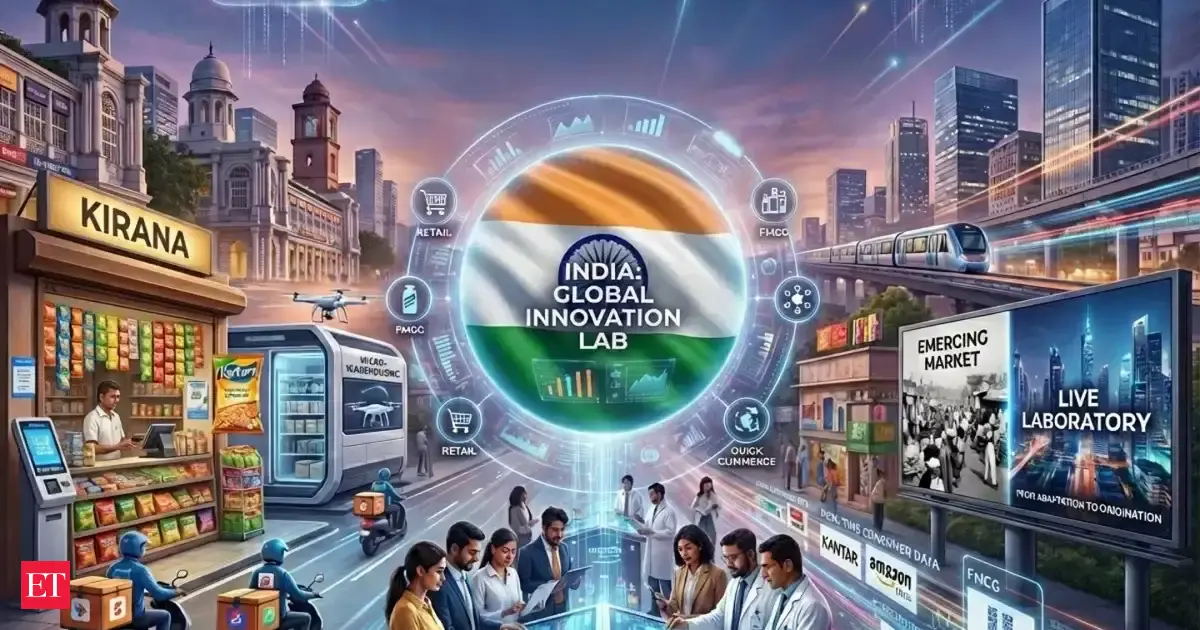
An interview published in ET today brings this shift into sharp focus. Kantar, the world’s largest data and insights company, now sees India not as a peripheral growth engine but as central to its global innovation strategy. Also Read: India a live laboratory for consumer intelligence, core to Kantar's growth, says CEO Zwillenberg “India is no longer just an emerging market story for us. It is core to how we think about innovation, scale and long-term growth,” Kantar’s global chief executive Paul Zwillenberg said in an exclusive interview with ET. He described India as one of the company’s most important markets, not only for local revenues and global clients served from here, but as a major centre for research, delivery and analytics. More strikingly, he called the country a “live laboratory for the next era of consumer intelligence.” That formulation captures the broader truth that India has become the testing ground for retail and FMCG experimentation. From “emerging market” to strategic core For a company like Kantar, India’s complexity -- its multiple languages, income tiers, consumption habits and ecosystems -- forces sharper, more flexible innovation. What works in Mumbai may fail in Lucknow. A product embraced in Bengaluru’s tech corridors may struggle in Bihar. This fragmentation becomes a stress test. If a strategy survives in India, it is likely robust enough for other volatile or heterogeneous markets. The quick-commerce crucible The rise of quick commerce has intensified India’s role as a test bed. Grocery deliveries in under 10 minutes are no longer novelties in urban India. Global companies are watching closely. Amazon, for instance, has taken lessons from its Indian operations to other geographies. According to Udit Madan, a senior vice president of global operations, the company has launched Amazon Now in the UAE, Egypt, Saudi Arabia, Mexico and parts of the United States. Two US cities now experience 30-minute delivery models inspired in part by Indian experimentation. India’s dense urban clusters, traffic constraints, mixed digital payment habits and hybrid retail infrastructure have forced companies to design hyperlocal fulfilment models that balance speed, cost and inventory efficiency. Those models are now being adapted to markets where last-mile challenges resemble India’s. The innovation is not merely about speed. It is about orchestration too such as micro-warehousing, dynamic inventory, kirana partnerships and digital-first consumer interfaces. The intensity of Indian competition, between homegrown startups and global incumbents, compresses innovation cycles. What takes years elsewhere can take months here. Kirana logic goes global One of the most consequential Indian innovations has been the systematic integration of neighbourhood stores, or kiranas, into modern e-commerce supply chains. After Walmart acquired Flipkart in 2018, it inherited not just a large online retailer but a hybrid retail philosophy. Flipkart had pioneered models where local stores acted as delivery hubs, return points and assisted-buying agents. This allowed the company to extend digital commerce into neighbourhoods where trust in local retailers remained strong. These blended offline-online networks became templates for Walmart’s small-store partnerships in Mexico, Chile and parts of Central America. Markets with fragmented informal retail structures found resonance with India’s kirana ecosystem. Similarly, Amazon’s Hub Points programme, under which it ties up with local stores for package drop-offs, originated in India before finding parallels in rural Spain and eventually in US cities such as Manhattan. The idea that small, idle retail spaces can become logistics nodes has proved globally portable. India’s dual retail system, organised chains coexisting with millions of independent stores, compels companies to design flexible distribution systems. When those systems work in India, they often travel well to other emerging markets with similar retail fragmentation. The sachet revolution and affordability engineering Long before quick commerce, India had already reshaped global FMCG strategy through pricing innovation. In the 1980s, Hindustan Unilever, the Indian arm of Unilever, introduced single-use shampoo sachets to address low purchasing power. Instead of selling only full-sized bottles, the company offered ultra-affordable units that dramatically expanded the user base. The sachet model converted non-users into regular consumers and permanently altered packaging logic. It migrated from India to Indonesia, the Philippines, Vietnam, Kenya and Nigeria, embedding itself in the playbooks of global FMCG companies targeting price-sensitive markets. Hindustan Unilever’s Project Shakti in the early 2000s further cemented India’s reputation as a distribution innovator. By training rural women as micro-entrepreneurs who distributed products in villages, the company created an alternative last-mile network in areas with weak infrastructure. Variations of this rural direct-distribution model were later replicated in other developing markets. India’s combination of scale and poverty forced companies to master affordability engineering, rethinking unit size, pricing architecture and distribution incentives. That expertise has proved invaluable in Africa and parts of Latin America. Local tastes, global travels India has also generated product formats that travel beyond its borders. In 1999, PepsiCo’s India arm developed Kurkure, a snack tailored to Indian flavour preferences and texture expectations. Its success led to expansion into Pakistan and Bangladesh and later into diaspora markets in Canada and the US. Coca-Cola has similarly used India to test smaller, affordable PET bottle formats such as 200ml and 250ml packs. These experiments informed packaging strategies in several African and Latin American markets where affordability remains crucial. These examples underline a shift from adaptation to origination. India is no longer merely receiving global products; it is generating them. Why India works as a laboratory India’s suitability as a global test lab rests on structural features that few countries combine. With its vast population, companies can pilot innovations in micro-markets such as affluent urban enclaves, middle-income tier-two cities and low-income rural districts, within one national boundary. Each micro-market approximates a different emerging economy. Secondly, diversity helps. Linguistic, cultural and income variations compress multiple consumer archetypes into a single geography. This heterogeneity forces granular segmentation and agile marketing. Retail duality is another unique feature. Organised retail chains and advanced app-driven supply systems coexist with cash-based, relationship-driven kirana networks. Companies must design systems that function across both. Over the 2010s and early 2020s, rapid smartphone adoption and low-cost data transformed India into one of the world’s largest digital markets. Yet traditional trade did not disappear. The coexistence of legacy retail structures with cutting-edge digital commerce creates a rare hybrid ecosystem. Intense competition makes India a perfect testing ground. Domestic startups, regional champions and global giants compete aggressively on price, speed, packaging and branding. Surviving in such an environment demands constant iteration. For data firms like Kantar, this makes India a real-time observatory. Consumer behaviour evolves visibly and rapidly. Trends such as premium ayurvedic beauty brands, hyperlocal grocery delivery and regional language digital content generate datasets that are both massive and nuanced.
Comments (0)
Sign in to join the discussion
No comments yet. Be the first to share your thoughts!